
Sora
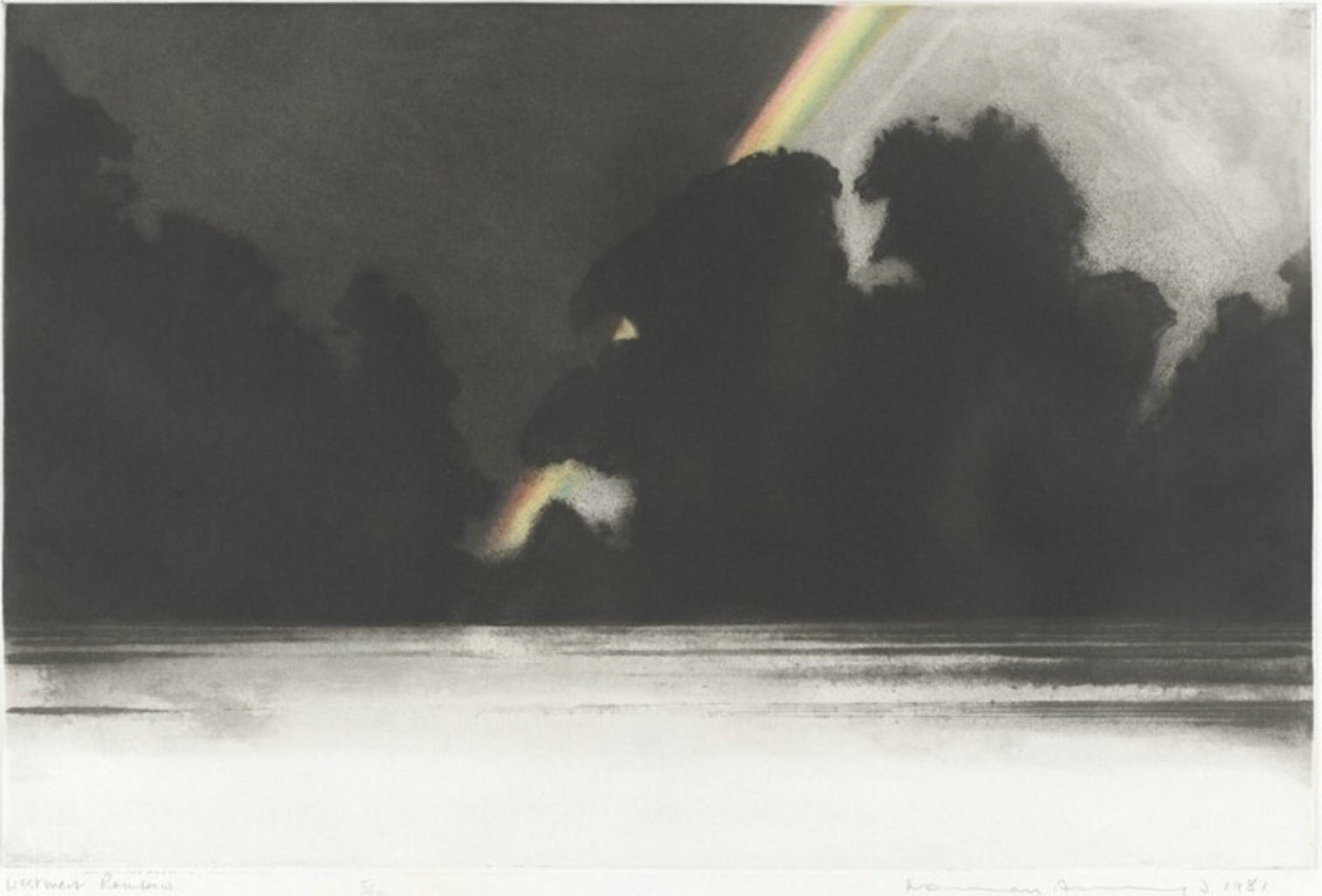
Westmere Rainbow (1981) by British printmaker and artist Norman Ackroyd
This story first appeared in the multi-media anthology, Weather Reports, edited by Jon T., in 2025. If you enjoyed this story, please consider ready the other entries. It’s a real trip.
I’m not superstitious. If I was, maybe I’d say I conjured the Weather. There were countless, careless ways I could have done it. Maybe over a glass of wine at the bar, ringing my finger around the sharp lip until it sang. Maybe over a cigarette passed between colleagues, condensing conversations into lint-grey clouds. Sora said, and it was so.
My mother had always warned me about the power of words. When I was nine, during one of those endless summer holidays, I was busy doing nothing at all but squatting on the porch, poking ants with a bamboo cane. They had found the sucked stone of my nectarine, stringy with sweet flesh, and formed a conga line all the way to the lawn. My mother swung open the back door and watched—flour-dusted hands on hips—as I tried to break up the party I’d started.
“Make yourself useful, Sora,” she said, plucking the stone and throwing it in the long grass. “Go weed the garden.”
“Yes, Ma.” Disobedience never crossed my mind. It would be like arguing with the sun, something only the village idiot would do.
I remember how her rubber boots gaped around my small ankles. They wheezed like an accordion whenever I bent to grab fistfuls of purslane and bindweed. Eeeee-uhhh. Eeeee-uhhh. Over the next few hours, my feet wore a path from the raised garden beds to the compost bin. There were patches of ridged courgettes, their orange flowers spreading like flames, and towers of runner beans and tomatoes. I pulled one from its vine and bit into it like an apple, sweet and sour. A wash of sugar and soil on my fingertips. As I grabbed another, a frog jumped from a leaf and fell somewhere into the dense green shade below. I wrenched my hand away, goosebumps crawling up my arm.
My mother didn’t laugh at my tears or scold me for dragging mud into the house. She slid the plate she was washing back into the tub, dried her hands roughly, and scooped me up, though I was starting to outgrow her by then.
“It touched me, I swear,” I said, breathing heavily into her shirt. “Am I going to die?”
“No, Sora,” she said, caressing my hair. “Frogs bring good luck.”
This was inconceivable, but my mother had never been wrong about anything. I looked at her and then at my hand, hoping and unhoping for something to appear. A black stain, or a blister.
“But they’re so gross, Ma. So slimy, and slippery, and cold,” I said, as if that was the worst offense of all. “I wish they’d all go extinct.” The last word came out more like a hiss thanks to my missing front teeth, and because Miss Hale preferred to say ‘dying out’ in Science class. I hadn’t had much chance to wrap my tongue around it.
“Careful, Sora,” my mother said, pinching my cheek. “The mouth causes trouble.”
The next day, I found a frog where the nectarine stone had been. But the ants had found it first.
The cleaner saw it first. I never asked her name. I had never asked her anything, until that day. That says more about me than I’d like.
She was mopping the hallway that ran between classrooms, trailing dilute bleach under the fluorescent lights, an ersatz of sunlight and swimming pools. Hair tied back in a low ponytail. A pink-cased phone wedged into tight jeans.
I closed my office door and skirted around her, making a show to tread lightly on the shining floor—wanting her to know that I got it, that I wasn't like the other professors, that I wasn’t born with a silver spoon.
“Dr. Tanaka?”
I turned around. It was the first time I’d looked at her properly. There was so much of my mother there. Something in the wide-set eyes and downturned lines around the mouth, surgically straight like someone had cut her.
“Sorry?”
“You seen outside?”
That's when I noticed it, the hum. I looked up at the lights, expecting to see a flickering bulb.
“What, sorry?”
She stepped forward, propping herself against the mop. The air sweetened with vanilla and coconut, and I was tugged far away—to the shade of a tree, folded in my mother’s lap, an ice cream running down my wrist. A deep ache burned in my chest.
“They work you too hard, Dr. Tanaka,” the cleaner said, shaking her head. “Go look. Everyone else is.”
I walked down the hall. The hum and perfume followed. Everything felt a little out of kilter, like the strange logic of a dream.
I entered the staff room. Every faculty member stood darkly by the window. The postdocs pressed against the glass; their lithe arms crossed above their heads. A forest reaching for the sky. Andrew, Otto, and Catherine stood in a row behind them, cradling cups of coffee. A faint light filtered between their bodies, colouring the white curls of their hair and painting rainbows on the lint-grey carpet.
“What is it?” I said, sliding next to them.
“You tell me,” Catherine said, her blue eyes searching mine.
Ahead, veils of iridescent clouds shimmered in the darkening sky, shifting from gold to pink to violet to green and gold again. Beneath, spires of shadows crept up from the horizon. Coal-black. Slow, black. As patient as stalagmites, rising over eons. One by one, they speared the emerging stars and plunged us into night.
I reached for Catherine's hand, but found she was already holding mine.
The lecture hall was filled to the rafters. I could see the faces of my students, chittering excitedly like birds a few rows back. Others I recognised from the general milieu of the university.
Andrew lounged in the front row, cat-like in a cashmere suit. He had never hidden his disdain for his non-analytic colleagues. He thought continental philosophy was too abstract, alienating, and, worse, deeply unserious.
When he took over the department five years ago, I was certain it was only a matter of time before I was kicked to the curb. Certainly, there was no longer a budget for studentships—those times were long gone—and his first review of my course was acerbic. We teach philosophy not poetry, Sora. And this would make very poor poetry at that. Still, I’d clung on as a kind of ghost species.
Everyone wanted to pick his brain when all this started. He appeared on In Other Words, a podcast where the good and great went to opine about the ills of the day and plug their latest book.
“It’s human nature,” he said, his voice a slow and steady metronome. “You just have to look at how our ancestors responded to similar phenomena: eclipses, floods, plagues. They invented stories by way of explanation. But the philosopher’s role here is to hold the line against such mythos. We must ask: What exactly is being claimed? Can it be proven?”
The mic popped and Andrew paused, taking a sip of water.
“Otherwise, I'm afraid, all statements thus far are, to put it in Ayer’s terms, really quite meaningless.”
“Welcome everyone,” I said, clearing my throat. “It’s great to see so many of you. Today, I would like to raise a simple question: do we share the same lifeworld?”
Andrew crossed his arms and slouched back in his seat.
“In the next twenty minutes, I would like to explore three things. First, why phenomenology calls us to bracket our assumptions about the Weather. Second, how the Weather disrupts our intersubjectivity. And, finally, reflect on what it might mean to inhabit alternate lifeworlds.”
I clicked the remote and a car-sized nose appeared on the screen behind me. A ripple of laughter ran through the hall. Andrew frowned.
“We take our experience of the world for granted. In daily life, we assume that we all collectively experience the same reality, or lifeworld,” I said, gesturing to our surroundings. “But what happens when our ‘natural attitude’, as Schutz put it, becomes disrupted?”
“Please raise your hand if you’ve ever smelled it. Something sweet? For me, it smells like vanilla, or coconut.” Like my mother, I wanted to say.
Slowly, hands rose in the air. There was no discernible pattern amongst the crowd, no common thread tying them together. Andrew looked around uncertainly, as if he’d missed the punchline of a joke.
“Thank you,” I said, indicating for them to lower their hands. “Many of you will know that smell directly routes to the brain’s emotional and memory centres. It bypasses the thalamus, which is responsible for conscious perception.”
I clicked again. A faded photo appeared of a young girl holding an ice cream.
“That makes it powerful—but also invasive. It enters us, acts on us. Smell can transport us through time or manipulate our emotional response. And here, with the Weather, it seems to act on our bodies differently.”
A murmur spread through the audience, soft as a wave lapping the shore.
“We assume we share the same lifeworld. But this…” I gesture to the ceiling, feeling the weight of the unseen clouds. “It feels selective or divisive, almost intentional. Like, we’re being attended to.”
Andrew shifted in his seat, his face growing pale. Pale as the inside of a shell.
“He’s challenging solipsism, right?”
“Go on. What do you mean by that, Amelia?” Even in the dim light of the seminar room, her freckled skin shifted from olive to peach to grey. On the blank walls, the iridescence moved back and forth like an oil spill. The hum was barely audible, as soft as breathing. I could almost forget it in those moments.
“Like, he’s challenging the idea that I can only know that my mind exists,” Amelia said, gesturing to herself. “It's a rejection of Cartesian cogito.”
Robert leaned forward, as if ready to catch a ball. Those were some of the best moments, when I could almost see the ideas passing from student to student, when they were so eager to tag in.
“Yeah, at the start of the book, Merleau-Ponty suggests, like, a third way. Something different from mind-body dualism. What did he call it?” He asked, flicking back through the pages of his notebook. “Le corps proper?”
“Le corps propre, yes,” I said. “That we are a body-subject—someone touching, something touched.”
Even now, I hate correcting speech. How long ago had that girl wrinkled her nose at me? Fifteen years? Twenty? We’d been reading The Metamorphosis. Not all translations are equal, but some are eternal, Mr Wood told us. Gregor is a monstrous vermin, not a bug. The girl echoed him a beat or so later, always a suck up. What was the word? Ennui, that’s right. It’s pronounced like on we, she said, not anew.
“Right, so Merleau-Ponty says that’s not really a thing. We’re not brains in a vat or however Descartes would put it,” Robert said, waving his hands like he was swatting flies. “He says we’re bodies, living bodies.”
“Well, M.P. sure talks a lot about fleshiness in this one,” Peter said, holding up a battered copy of The Visible and the Invisible.
“Good. But we're getting a little ahead of ourselves,” I said, resting against my desk.
“Let’s return to Phenomenology. Here, Merleau-Ponty describes how this awareness of the Other can be strange, uncomfortable even. Amelia, can you continue reading from the top of page 412?”
“Round about the perceived body a vortex forms, towards which my world is drawn,” Amelia said, reciting each line with the care of a poet, “and, so to speak, sucked in: to this extent, it is no longer merely mine…”
In the distance, the hum lifted higher. A mosquito creeping near my ear, threatening to burrow inside.
“...Already the other body has ceased to be a mere fragment of the world and become the theatre of a certain process of elaboration, and, as it were, a certain ‘view’ of the world. There is taking place over there a certain manipulation of things hitherto my property.”
I tried to focus on her face, miming each word with her, but its edges were slippery and ill-defined in the churning light. Eye became nose. Nose became mouth. I felt the sky press upon the window and my cheek. My stomach vaulted. It took all my strength not to look out the window.
“Someone is making use of my familiar objects,” Amelia said, her hand trembling slightly. “But who can it be?"
“Stop there.”