
The Thing That Blights
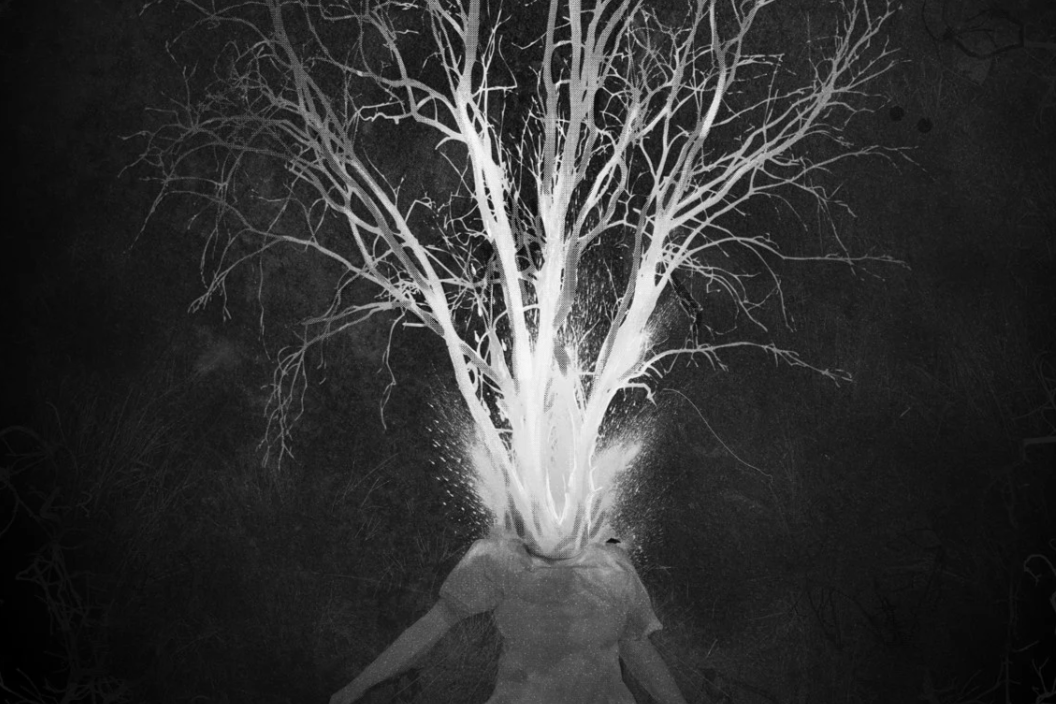
Illustration by James Powell, Grey Bear Design
This story first appeared in Issue 4 of CloisterFox, an independent, bi-annual zine dedicated to British speculative fiction and uncanny short stories. CloisterFox is edited by author Verity Holloway and illustrated by James Powell. If you enjoyed this story, please consider buying an issue.
The pear tree had to come with them. Before they polished the silverware and laid each spoon and knife and fork neatly in its velvet bed in the wooden case. Before they wrapped the fine dinnerware, decorated with pink roses, in brown paper and bubble wrap and nested them into cardboard boxes. Before, even, they took down the photographs in the hallway, bleached and yellowed from the sun, and put them carefully away. The pear tree came first.
Beth knew it was her turn before she was asked. Anne lay in bed slicked with sweat, writhing like a fish caught in a net. She cupped a hand keenly between her thighs, as if she could hold back the red tiding rising across the sheets. Henry kneeled by her side, pale and frightened.
“It’s okay,” Beth said, touching his shoulder. “Mum’s fine. Why don’t you get her a glass of water?”
Henry left hurriedly; his face fixed on the floor. Anne’s blue eyes stared up, vacant and glassy. Her breaths were fast and shallow, fluttering like a moth around a flame. I should call someone, Beth thought as she stroked her hair, her fingers trembling. At her touch, Anne drew back into the room and noticed her standing above.
“It’s almost over,” Anne said, every word condensing in the cold air. “Be careful.”
Beth grabbed the shovel by the back door, hidden behind umbrellas and raincoats and wellington boots. It was still caked in mud, hanging in dry sharp clumps, as if they’d only just planted the tree and not eight years ago. It was by far the longest period they’d stayed in one place, Beth thought as she made her way up through the garden. She could barely remember living anywhere else.
The sky was white, and the wind whipped through the orchard, making the brittle fingers of trees crook and bend, and her ears ache with cold. The only sounds she could hear were the crunch of her boots and the tip of the shovel dragging along the frozen ground. She tightened the scarf around her neck.
The pear tree stood at the far end of the orchard, surrounded by smaller apples and plums and cherries—all rendered bare and ashen by winter. The pear tree’s branches reached high above the orchard, mottled by the dense tufts and scabs of mosses and lichen, and etched rune-like marks into the sky. When Beth was a young girl, no more than eleven, she would sit in the shade of the tree during the summer and read until the shadows grew long and dark and her mum called her in for tea.
Anne had chosen this spot when they moved in, digging deep into the earth as Beth watched her pregnant belly sway back and forth. It was a hole, that was all—reddish brown and claggy. But to Beth it was an archaeological site, where bones and ruins could be dredged from the ground and once more exposed to the sky.
This tree has been in the family for eighty years, her mum said. Your grandmother planted it in her garden during the Second World War. It’s brought us good luck.
Beth perked up at this, imagining the shovel striking buried treasure—a chest stuffed with glittering coins and jewels from kings and queens long gone—and peered down into the hole.
What kind of luck?
The kind you’ll be grateful for one day. Can you pass me that twine?
A robin landed on the tree, a flame against the gloom. Though the wind rippled through its feathers and bowed the branch beneath its feet, the robin rose its head proudly to the sky. As it began to sing, she pierced the ground.
Their new home was on the outskirts of Crowcombe, a small village nestled in a hollow under the Quantock Hills, where exposed heathland and wild wooded valleys swept from Taunton to the sea. It was a simple cottage, made of cob and stone, a little run down—as things sold at auction often were—and unchanged since the 70s, with melamine cabinets, shag carpets, and an old gas fire that Beth and her younger brother Henry huddled in front of in the evenings.
Beth ached for their old home. She missed the gnarled wisteria, whose confetti flowers bloomed across the kitchen window in May. She missed the black-faced sheep chewing on comfrey and clover on the boundary. She missed the morning light that filtered through the stained glass windows and scattered red and amber on the wooden floors. Most of all, Beth missed the feeling of home.
When they had first entered the cottage, stepping over piles of leaves and letters, Beth had felt a despair so keen and sharp that she expected to look down and see a knife twisting into her heart. Henry grabbed her hand, but they said nothing in front of Anne, who was already opening the back door to inspect the garden.
We’ll be happy here, Anne had declared. It’s a good place to put down roots.
She was right, in a way. The pear tree flourished in the new soil. Every branch filled with sleeping buds, swaddled tightly in white, and the curled-up tendrils of leaves. Beth stared at the circular patch around its base, which delimitated where they had dug into the grounds and where they had buried the remains. Whether Anne had miscarried a brother or sister, she couldn’t be sure, but when she had laid it down into the sodden clay alongside spidery roots and wriggling worms, Henry had begun to cry.
We’ll always stay together this way, Anne had said. They’ll be a part of us.
Then they had scattered soil over its small, shrouded body and lowered the great weight of the tree.
As the weeks turned to months, spring brought blue skies and sun. They scrubbed, painted, and polished until the cottage began to resemble something like a home. For almost every day in April, they flung open the windows to blow away decades of dust and breathe new life into the cottage. Each room filled with the sounds of chattering birds and woken bees. As she washed tea-stained mugs in the warm soapy bowl in the sink, Beth could even hear the high-pitched bleats of lambs. The knife in her chest stopped twisting and left a dull ache.
Anne found a new job as a carer in the local hospice, working long nights tending to the sick and dying. She preferred working the night shift, but Beth never felt at ease until she heard the keys jingle in the door and the footsteps on the stairs, heavy with tiredness. Since Henry was born, many of Beth’s days had been filled with minding him while their mum slept. Not for the first time, she wondered what would happen to Henry when she left home. She was old enough now that the future was becoming less of an abstract thought, but something she needed to prepare for and possibly arm against. Did she even want to leave? Where would she go? What would she do? She never broached the topic with Anne. It never seemed the right time. She was needed too much. But she felt they were starting to circle it in their conversations—skating around the unsaid in great loops that were drawing closer and closer until one day there would be nothing else to talk about.
On the warmer days, she would take Henry outside and teach him about plants, insects, the sights and sounds of birds, and, of course, the pear tree. Sometimes they would walk across the heath to Dead Woman’s Ditch and forage for nettles and wild garlic on its mossy banks, plump with white and yellow primroses.
On her days off, Anne would sometimes walk to the village pub, The Carew Arms. Beth stayed at home to look after Henry, but she would imagine Anne sat by the fire in the inglenook or throwing her head back in laughter at something the landlady had said. The move was good for her. Even the crow’s feet around her eyes had softened.
One night, she returned with a stranger and a bag heavy with food. The man was tall and plain. He wore a large blue jumper and brown leather boots. As he swayed and smiled to himself, Beth realised he was drunk.
Anne laid down the bag on the table and unwrapped the fish and chips, the smell of vinegar filling the kitchen. She popped a chip into her mouth and winked at them.
“This is Ben. We met at The Carew.”
“That’s right,” Ben said with a squint, as if he was trying to draw them into focus. “Nice to meet you.”
“You’re okay to look after Henry, Beth? Can you make sure he eats?”
“Yes,” she said. Resentment pooled in her stomach, thick and acidic.
They went upstairs together, Anne giggling as they ducked under the wooden beam of the mantle. Beth heard the metallic latch of the door clinked shut. She switched on the television before they, and particularly Henry, heard anything else.
They tore into the chips and fatty chunks of cod, steaming in their mouths, and glazed their fingers with salt and oil. She turned the volume up to stifle the moans coming overhead. Henry remained oblivious, transfixed by heroes saving the world from disaster over and over again, stuffing strips of gold batter into his mouth.
In the early hours of the morning, as dawn slipped through her window, she heard the front door shut and steps crunch on the gravel drive. She never saw the man again.
As the days and weeks gave way to May, Anne took her to the pear tree. The buds had transformed into white flowers surrounded by emerging leaves.
“We’re due a frost,” Anne said. “We better cover it.”
They each picked up a large bamboo cane and gently hoisted the net high over the tree, careful not to dislodge the delicate blossoms. The net billowed like a sail to the ground.
Anne placed her hands on her hips and arched her back. Beth could see the faint curve of her belly. Anne caught her gaze and smiled at the tree.
“Looks like we’ll both be bearing fruit this autumn.”
Beth watched the net shiver in the light breeze and imagined the petals peeling open to reveal the crowning heads of fruit.
Summer was a washout. Beth stared at the beads of rain on the window. The backdoor was open, and a puddle had formed at the threshold. Beyond the garden, clouds rested on the hills, and the whole sky was grey and sullen. Henry sat at the kitchen table, doodling endless worlds of his imagining.
One of the drawings showed a large tree with branches reaching high into the sky, so high they almost touched the sun. Every branch bore fruit of all shapes, colours, and sizes and Beth thought of the box of marzipans an old neighbour had given them one Christmas, where every technicolour pear, orange, banana, and strawberry looked realer than in life. Beneath the tree, a woman, a girl, and a boy held hands.
“Have you showed Mum this, Henry?” Beth said, holding it up. “She’ll love it.”
Henry smiled shyly and held his pencils close to his chest. “Maybe when Mummy gets up.”
As if on cue, Anne entered the kitchen. She was dressed in blue scrubs and had her long hair pulled back into a ponytail, ready for the night shift. Even in her baggy clothes, her pregnancy was more noticeable now. Her face looked tired and gaunt.
“Okay, Mum?” Beth asked. “Did you sleep okay?”
Henry held up his drawing to show her, but she went straight to the doorway and stared out at the garden. She said nothing. Beth made her a tea, which she swilled slowly around her mouth—as if the liquid might contain the right answers if she was deft enough to sift for them.
“Something’s not right. Come with me.”
The scene was composed like a play: the pear tree lit up on the stage. In the wide open clearing, the tree glowed in the evening sun, which had pierced through the gloom and scattered gold across the fields. Behind the tree, towards the hills, the sky was as black as a backdrop, heavy with clouds. Anne studied the tree for a moment, prodding at weeping knots on the bark, then grasped a leaf between her fingers and showed Beth. Dark brown spots and perfect holes mottled the surface, as if someone had been putting out cigarettes. She didn’t know what she was looking at.
“Shothole.”
“What?”
“It’s diseased.”
The solution was drastic. The next day, they cut off the affected branches, where bark peeled off like flesh from bones and sap oozed out as thick as treacle, and threw them into the bonfire. Sweet smoke filled the garden, catching in their throats and making their eyes water. With every severed branch, Beth felt like they were committing an unforgivable act.
When they were done, they sat in the grass and looked at the pear tree. It was a violent sight; the magnificent canopy was half its size and everywhere there were bright white stumps where they had so ruthlessly dismembered it.
Under the overcast sky, Anne looked sick with worry, and older, as if the last few hours had wound the clock forward by a decade. Beth wondered if the weather was responsible, shifting hues in some trickery of light, or if there were a few grey hairs sprouting from her head. She had never understood her family’s tie to the pear tree, it seemed like a great weight on their back if anything, but now they were facing its loss, a deep sense of grief ran through her bones. It was a link to the people they’d loved and the places they’d lived, going back generations. The pear tree had been wherever they’d called home, and home was wherever the pear tree was planted. Her cheeks burned with shame for ever having the thought of leaving.
“Do you think it will be okay?” Beth said.
Anne picked at the grass by her feet, then said, “Over the years, I’ve tried to impress the importance of the pear tree, but there’s only so much I could say. You were so young. Now you’re coming of age, I think I should tell you.”
Beth thought of the photograph in the hallway of the grandmother she’d never met. The young sapling in the garden. The sounds of air raid sirens.
“I’d like to learn more about it… more about our family.”
“It’s not…” Anne paused, collecting herself. “The tree will live, you see. I think it will, anyway. But that’s not what I’m worried about.”
“What are you worried about?”
“I’ve asked for too much. It might not fruit again.”
At that moment, a clap of thunder rolled down from the hills, and the rain poured and poured. Then, a scream ran out from the cottage.
Henry was lying on the floor shuddering, next to a broken bowl of spilled milk and cereal. His head slumped to one side and only the whites of his eyes were visible. All over his body, dark brown spots wept with orange pus. Beth felt the world close around her.
“What’s happening?”
“Hold his head. Now.”
Beth’s hands trembled with the effort as Henry jolted, though they would have trembled regardless. Anne carefully pried open his mouth—his tongue was swollen, pale, and covered in white sores.
“Let’s get him to bed. Grab the tea towel.”
Long after the sun set, long after they lathered his skin in calamine lotion, long after they tempered his fever with spoonfuls of medicine and soft caresses, Henry finally fell asleep. Anne knelt at the end of the bed, her face resting on her arms. In the silence, images flashed through Beth’s head. She saw spotted leaves. She saw oozing skin. She smelled rot and gangrene and pestilence and death.
“What’s going on?”
“Something has to give.”
That night, Beth tossed and turned, unable to sleep. The day’s events went around and around her mind until she was dizzy and breathless. A small part of Beth, a part she didn’t want to acknowledge, knew they were connected.
Early in the morning, she heard the door to Henry’s bedroom open, and someone—Anne from the rhythm and weight—walked across the landing to the bathroom. She tried to listen to the movements, for a sign that things were going to be okay. Please get better. Please get better. She thought over and over until her eyelids grew heavy, and she gave in to nothingness.
The next day, under the butchered pear tree, she found a small mound of soil. At the kitchen table, Anne looked ashen and empty. “The soil is a witness. It turns age into youth. Death into life. Wait and you’ll see.”
It was autumn, and everything had turned to gold. In the mornings, mist settled on the hills beyond the garden, dew hung to every blade of grass, and dry leaves swept from the ancient woodland to every nook and cranny of Crowcombe.
After Anne’s offering, Henry’s health had improved—Beth couldn’t deny the two were connected, somehow—but it had changed him. All over his face and body, she could see fresh pink craters from where the pox had been. Will they mark him for life? She thought. Will people be cruel to him? Now, they could only walk so far over the Quantock Hills before they had to camp among the sprouting heather and let Henry rest for a while, his heart thudding like a drum. Beth would point at the wild mushrooms in the fields—round giant puffballs, well-baked penny buns, and red and white spotted fly agaric—or the ripe sloes and whortleberries glowing like amethysts in the hedges, but he would barely raise a smile. It was as if all the colours had faded from his sight.
One day, she set out alone to forage for tea. It was the time of year when land was the most generous. As she walked under the copper trees, transfixed by the dappled light creating lace-like shadows on the ground, she could almost forget the sorrows that had transpired since they’d moved. She came back with a plastic bag full of blackberries and apples, the handles pulling tight on the joints of her fingers. She decided to make Henry his favourite pudding, a crumble with lashings of cinnamon and custard. Maybe that would make him smile.
When she got home, her mum was making a cup of tea in the kitchen, humming gently as she stirred a spoon. She looked at Beth and her spoils.
“You have been busy. What are you going to cook?”
They stood together by the counter, rubbing butter into flour to make crumbs. Her mum cored the apples, carving out pits and bruises with a paring knife, and held each berry to the light, looking for signs that an insect may have made a home there.
As they closed the oven door, a blackbird flew against the window with a thud, knocking over propped-up pictures on the windowsill. Beth picked one up that had cracked hard against the tile. She felt the breath leave her. It was a photograph she had looked at so many times before. Particularly at Christmas and birthdays, she’d sit on her mum’s lap and ask her for stories about their family and where they had come from. What were your parents like? She’d ask. What was Dad like? Do I look like him? Anne would talk for hours and hours until the fire burned out and it was time for bed. It was a black and white photograph, stained and spotted with age, of a woman planting a young tree in the garden.
“Is this you?”
Anne sighed and put down her cup. Silence filled the room for eternity seemed before she gave the answer that Beth already knew—the answer she had been deathly afraid to bring to the light.
“Yes.”
“How old are you?”
“I told you the tree brings good fortune.”
“It hasn’t for a while though, has it?” She said, anger rising in her throat. “How could you call this good fortune?”
“I got too greedy. A healthy tree needs to be pruned. It can’t sustain all the fruit… you have to be selective.”
“What does that mean?”
Anne walked outside with purpose. Beth followed, right on her heels.
“You need to talk to me, Mum. Please talk to me.”
Anne stormed up the pear tree, her long hair whipping behind her. She picked up a pair of loppers lying in the long, dried grass, and turned around to face Beth.
“I’m sorry, my darling,” Anne said, her eyes filling with tears. “If the tree doesn’t bear fruit, cut it off at the base.”
Anne held the loppers aloft, their sharp blades glinting in the sun. In one swift motion, she decapitated herself. Her head dropped to the floor and rolled up against the tree. Her knees buckled and the stump of her neck tipped forward, gushing blood all over the parched grass. All that Beth could hear was roaring. Her scream echoed through the garden and sent birds scattering across the sky.
Then, after a moment, the leaves of the tree lifted up, as if carried by a breeze. Every brown and tattered grew lush and green and waxy. Every shrivelled fruit grew plump and ripe and swollen. Under the weight, a branch bowed towards Beth with a single golden pear. She plucked it. It felt like the most solid thing in existence.
She walked away from the tree and out of the garden, afraid to look again at the ground, into the cottage and up the stairs.
In his bedroom, Henry lay propped up with pillows, a book unread on his lap. Fine blue veins showed through his paper-thin skin. She handed him the pear.
“Eat.”
He bit sharply into the flesh. The sweet juice ran down from his mouth and streamed under his chin. He looked at Beth and smiled as his cheeks flushed pink and rosy. His eyes shone bright and alive.
“It’s good.